Choosing a Garden Awning: Size, Projection and Sun Direction
A garden awning can make a patio or seating area more comfortable by creating shade where it is needed. Choosing the right one involves more than selecting a fabric or colour. Width, projection, mounting height and sun direction all affect how useful the finished installation will be.
When comparing garden awnings, start with the area you want to cover and the time of day you expect to use it most. A well-sized awning should provide practical shade without blocking too much indoor light or extending into an unsuitable part of the garden.
Start with the Area You Want to Shade
First decide which part of the garden needs shade. This may be a dining area, seating zone or wider terrace.
Measure the usable area rather than estimating from the wall. Note where furniture sits, how people move around the space and whether doors or windows need to open freely. Shade also moves during the day, so canopy dimensions alone do not show exactly where it will fall.
Think about whether you mainly need shade close to the house or further out on the patio. This can make a significant difference to the projection you need.
Choosing the Right Awning Width
Awning width is the measurement across the wall from one side of the unit to the other. A wider awning can shade a broader area, but it still needs to suit the building and available fixing space.
Check the wall for downpipes, lights, vents and other obstacles. An awning often looks more balanced when its width relates clearly to the opening or outdoor area beneath it.
Do not assume the widest option is automatically best. An oversized canopy may add unnecessary visual bulk and could reduce daylight entering nearby rooms.
Understanding Projection
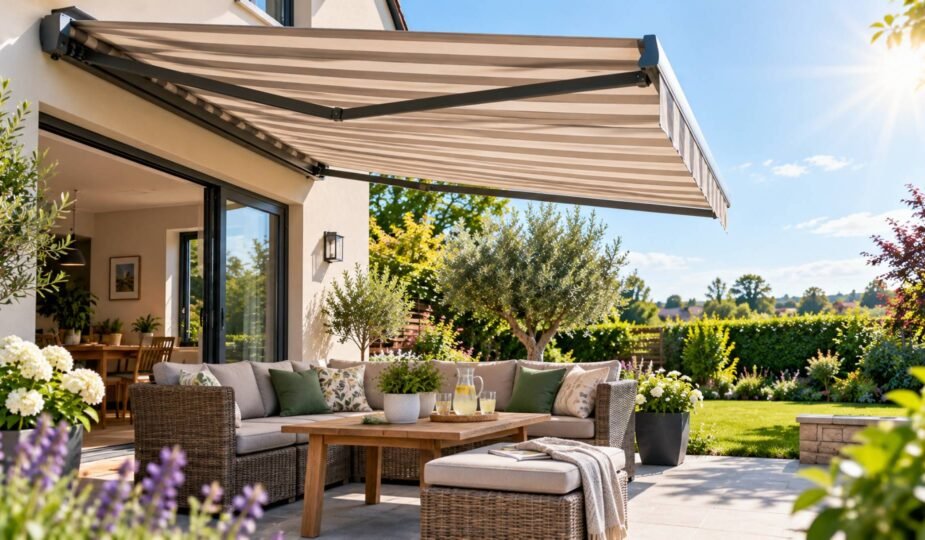
Projection is the distance the awning extends outwards from the wall when open. It has a direct effect on how much of the patio can be covered.
A larger projection may suit seating positioned further from the house. A shorter projection can be enough for a narrow patio or small area beside doors.
Also consider head clearance at the front edge. Awnings normally need some slope, so the front can sit lower than the mounting point. Projection, pitch and fixing height therefore need to work together.
Check the Direction Your Garden Faces
Sun direction is one of the most important parts of planning.
South-facing gardens often receive direct sun for longer periods. East-facing areas tend to receive more morning sun, while west-facing spaces can experience stronger low-angle sunlight later in the day. North-facing areas may need less continuous shade, depending on the surroundings.
Compass direction is only a guide. Trees, neighbouring homes, extensions and fences can all change how sunlight reaches a patio. Observe the area at different times on a bright day before choosing the size.
Allow for the Sun’s Angle
The sun changes height through the day and across the seasons, so the position of shade also changes. High summer sun is generally easier to block with an overhead canopy. Lower morning or evening sun may pass beneath the awning from the front or side.
This means more projection may not solve every shading issue. The pitch of the awning can also influence coverage. A lower front edge may block more low-angle sunlight, but it must still provide comfortable clearance underneath.
Measure Before You Choose
A few checks can prevent common sizing problems:
- Measure the clear wall width available for installation.
- Measure how far the patio or seating area extends from the house.
- Record the height above doors and windows.
- Check for pipes, lights, vents and cables.
- Watch where the sun falls in the morning, at midday and later in the day.
- Note whether trees or neighbouring buildings already provide shade.
These measurements provide a better starting point than choosing from appearance alone.
Think About Indoor Light Too
An awning affects the rooms behind it as well as the garden.
Shade can reduce direct sunlight and glare indoors during bright weather. However, a canopy that is larger than necessary may make the room feel darker when extended.
A retractable design gives more control because it can be opened when shade is needed and closed when more natural light is preferred. Consider both the patio and adjoining room before settling on the final size.
Consider Wind, Rain and Exposure
Weather exposure also matters. Gardens that are open, elevated or affected by wind between buildings may need more careful planning than sheltered patios.
Retractable awnings should not be treated as permanent roofs. Strong winds can place force on the fabric and supporting arms, while rain needs to drain correctly rather than collect on the canopy.
If the property is particularly exposed, professional advice can help with sizing, mounting position and fixing requirements.
When Professional Advice Is Useful
Some patios are easy to measure, while others have limited wall space, low eaves, large doors, unusual brickwork or nearby obstacles. In these cases, a professional site assessment can help confirm suitable dimensions.
It can also help where shade needs to fall over a specific seating area. A survey can consider wall structure, fixing height, projection, pitch and sun position together rather than treating each measurement separately.
Key Takeaways
Choosing the right garden awning depends mainly on width, projection and sun direction. Measure the area you want to shade, check the clear wall space and observe how sunlight reaches the patio during the day. Mounting height, indoor daylight and local weather exposure should also form part of the decision.
Avoid choosing by width alone. The most practical result comes from matching the canopy to the way the space is used and the path of the sun. Accurate measurements, combined with professional advice where the layout is difficult, can help you achieve useful shade without creating unnecessary problems.